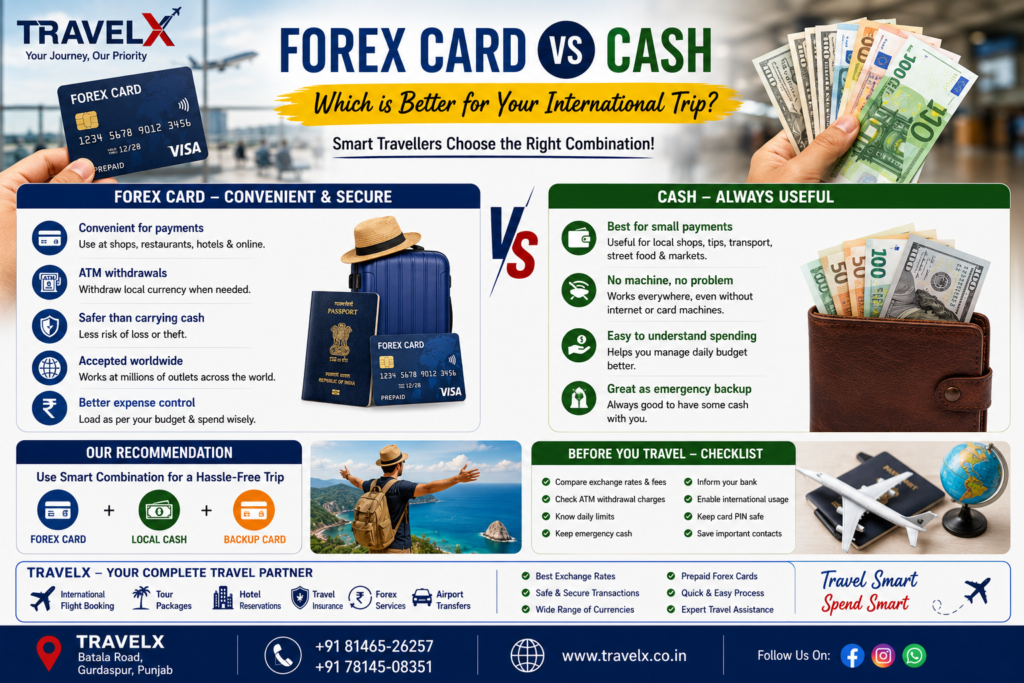
Forex Card vs Cash for International Travel: Which Is Better for Indian Travellers in 2026?
When you’re planning an international trip, flights and hotels aren’t the only things you need to arrange.
You also need to think about how you will make payments abroad.
Should you carry foreign currency cash?
Should you use a Forex Card?
Should you use your international debit or credit card?
Or should you use a combination of different payment methods?
For most travellers, there isn’t one perfect answer.
The right approach depends on your destination, spending requirements, convenience, fees, emergency needs and travel style.
This guide explains the difference between Forex Cards and foreign currency cash and how Indian travellers can plan their travel money more sensibly.
What Is a Forex Card?
A Forex Card is a prepaid travel card designed for overseas use.
Depending on the card and issuer, it can generally be used for eligible purchases at overseas merchants and may also allow ATM withdrawals.
RBI guidance has recognised prepaid forex cards for residents travelling abroad, subject to applicable requirements and conditions.
The exact features, currencies, fees and withdrawal conditions depend on the card provider.
What Is Foreign Currency Cash?
Foreign currency cash means carrying physical notes of the currency used in your destination.
For example:
🇦🇪 UAE Dirham for Dubai
🇸🇬 Singapore Dollar for Singapore
🇹🇭 Thai Baht for Thailand
🇬🇧 British Pound for the UK
🇺🇸 US Dollar for the USA
Cash can be useful for small purchases, tips, transport or situations where card payments aren’t convenient.
Forex Card vs Cash: Quick Comparison
| Feature | Forex Card | Foreign Currency Cash |
|---|---|---|
| Convenience | High | Moderate |
| Physical Loss Risk | Lower than carrying large cash amounts | Higher |
| ATM Access | Usually available, subject to card | Not applicable |
| Merchant Payments | Convenient where accepted | Widely useful |
| Emergency Backup | Useful | Very useful |
| Exchange Rate | Depends on card/load terms | Depends on exchange rate at purchase |
| Fees | May apply | Exchange margin may apply |
| Online Payments | Usually possible, subject to card | No |
| Small Local Payments | Depends on acceptance | Very convenient |
| Replacement if Lost | Provider-dependent | Cash generally cannot be replaced |
Important: Forex Card features and charges vary by issuer. Always check the provider’s current terms before purchasing.
Is a Forex Card Better Than Carrying Cash?
For many travellers, a Forex Card can be more convenient for a significant portion of their travel spending.
But that doesn’t mean you should travel with zero cash.
A practical approach can be:
Forex Card + Small Amount of Foreign Currency Cash + Backup Payment Method
This gives you multiple options.
Advantages of a Forex Card
1. Convenient for Overseas Payments
Instead of carrying a large amount of physical currency, you can use the card where card payments are accepted.
This can make spending more convenient during an international trip.
2. Useful for Larger Travel Expenses
Hotel payments, shopping and other larger transactions may be easier through a card where accepted.
Always check whether your hotel or service provider requires a deposit or a specific payment method.
3. Can Be Safer Than Carrying Large Amounts of Cash
Carrying a large amount of physical cash creates a risk if the money is lost or stolen.
A Forex Card can reduce the need to carry all your travel money in physical notes.
However, a card should still be protected like cash.
4. Useful for Online Payments
Depending on the card and merchant, a Forex Card may be usable for eligible online transactions.
This can be useful for:
- Travel bookings
- Online purchases
- Reservations
- Other permitted payments
Check the card’s online transaction conditions before relying on it.
5. Can Be Used at ATMs
Many Forex Cards can be used to withdraw cash from compatible overseas ATMs.
However, ATM charges, limits and exchange conditions can apply.
Always check:
- ATM withdrawal fee
- Daily withdrawal limit
- Currency conversion conditions
- Local ATM charges
Advantages of Carrying Foreign Currency Cash
1. Useful for Small Payments
Cash can be convenient for:
- Tips
- Small shops
- Local markets
- Small food outlets
- Transport
- Emergency expenses
2. No Card Machine Required
Cash doesn’t depend on:
- Internet
- Card terminal
- Mobile network
- Merchant card acceptance
This can make cash useful as a backup.
3. Easy to Understand Your Spending
Some travellers find it easier to control their budget when they physically separate their spending money.
For example:
Daily Food Budget
Shopping Budget
Transport Budget
This can help prevent unnecessary spending.
Disadvantages of Carrying Too Much Cash
Carrying large amounts of physical currency isn’t ideal.
Potential problems include:
- Loss
- Theft
- Misplacement
- Difficulty replacing it
- Difficulty keeping it secure
That’s why many travellers prefer keeping only a reasonable amount of cash and using electronic payment methods for other expenses.
Disadvantages of a Forex Card
A Forex Card also has limitations.
Depending on the provider, there may be:
- Issuance fee
- Reload fee
- ATM withdrawal fee
- Currency conversion charges
- Inactivity or other applicable charges
- Replacement charges
The exact fee structure varies by provider.
Always read the current fee schedule before loading money onto the card.
What About International Debit & Credit Cards?
Indian travellers may also use international debit or credit cards abroad, subject to their bank’s terms.
This can be useful as an additional payment method.
But before relying on your regular card, check:
- International transaction charges
- Foreign currency conversion charges
- ATM withdrawal charges
- Daily limits
- Card acceptance
- Bank security controls
Don’t wait until you’re abroad to discover that your card has an unexpected international usage restriction.
Should You Carry All Your Money on One Card?
It is generally better to avoid putting all your travel money into a single payment method.
Consider dividing your travel funds between:
💳 Forex Card
💵 Cash
💳 Backup Debit/Credit Card
This provides a backup if one payment method stops working.
How Much Cash Should You Carry?
There is no universal amount suitable for every traveller.
It depends on:
- Destination
- Trip duration
- Family size
- Planned activities
- Hotel arrangements
- Card acceptance
- Personal spending style
A better approach is to carry enough cash for initial expenses and backup needs, while keeping the rest in secure electronic payment methods.
Forex Card vs Cash for Dubai
For Dubai travellers:
🇦🇪 Forex Card
Useful for:
- Hotels
- Shopping
- Restaurants
- Larger payments
- ATM access
💵 Cash
Useful for:
- Small purchases
- Tips
- Local markets
- Emergency backup
A combination can be practical.
Forex Card vs Cash for Singapore
Singapore is highly card-friendly in many tourist and commercial areas.
A Forex Card can therefore be convenient for many purchases.
However, keeping some Singapore Dollar cash can still be useful for smaller expenses and backup situations.
Forex Card vs Cash for Thailand
Thailand offers many situations where having some local cash can be useful.
For example:
- Markets
- Small vendors
- Local transport
- Small food outlets
Therefore, travellers may prefer a combination of card and cash rather than relying entirely on one method.
Forex Card vs Cash for Malaysia
For Malaysia, travellers can similarly combine:
💳 Electronic payment
💵 Local currency cash
Your choice should depend on your itinerary and where you plan to spend.
What Should Students Carry?
Students travelling abroad for longer periods may have different requirements.
They may need money for:
- Food
- Transportation
- Initial accommodation
- Local setup expenses
- Shopping
- Emergency needs
A Forex Card can be useful for managing travel money, while some cash can be kept for immediate expenses.
Students should also keep an additional payment method as a backup.
What Should Families Carry?
Families should consider:
- Number of travellers
- Children’s expenses
- Daily spending
- Shopping
- Transport
- Emergency money
Instead of carrying a large amount of physical cash, families can divide their travel funds across multiple secure payment methods.
What Should Honeymoon Couples Carry?
Couples can use a combination of:
💳 Forex Card
💵 Local currency
💳 Backup international card
This provides convenience while reducing dependence on a single payment method.
How to Get Better Value from Forex
Before exchanging or loading foreign currency, compare:
Exchange Rate
Check the rate offered by the provider.
Fees
Look for:
- Card issuance
- Reload
- Withdrawal
- Currency conversion
- Other applicable charges
Convenience
A slightly better exchange rate isn’t always useful if the payment method is difficult to use.
Destination Currency
If your card supports multiple currencies, understand how transactions are processed.
Don’t Compare Only the Exchange Rate
This is a common mistake.
Suppose Provider A offers a slightly better exchange rate but has higher fees.
Provider B offers a slightly different rate but lower overall charges.
The better option should be based on the total effective cost, not just the displayed exchange rate.
What If Your Forex Card Is Lost?
If your Forex Card is lost or stolen:
- Contact the card issuer immediately.
- Block the card if required.
- Ask about replacement options.
- Use your backup payment method.
- Keep emergency contact details separately.
Never store your card PIN openly with the card.
What If Your Cash Is Lost?
Unfortunately, physical cash is generally difficult to recover once lost.
That’s another reason not to carry all your travel money in cash.
Keep your cash distributed safely rather than putting the entire amount in one wallet.
Travel Money Checklist
Before leaving India, check:
☑ Forex Card activated
☑ PIN secured
☑ Emergency contact saved
☑ Foreign currency arranged
☑ Backup debit/credit card ready
☑ International usage enabled where required
☑ Bank transaction limits checked
☑ Mobile banking available
☑ Important documents saved
☑ Some emergency cash kept separately
RBI & Foreign Exchange Rules
Foreign exchange transactions by Indian residents are governed by the applicable FEMA framework and RBI directions.
RBI guidance recognises authorised entities for foreign exchange and provides rules around travel-related foreign exchange and prepaid travel cards.
Because foreign-exchange rules and limits can change, travellers should confirm the current applicable rules and requirements with an authorised foreign-exchange provider before travelling.
How Travelx Can Help with Forex
At Travelx, Forex is part of our broader travel service offering.
Travellers can enquire about:
💱 Foreign Currency
💳 Forex Card
✈️ International Flight Booking
🌍 Tour Packages
🏨 Hotel Reservations
🛡️ Travel Insurance
🚖 Airport Transfers
Our team can help you understand the available options based on your destination and travel requirements.
Forex Card vs Cash: Our Simple Recommendation
For most international travellers, there is no need to choose only one.
A practical travel-money strategy can be:
💳 Primary
Forex Card / suitable international payment method
💵 Backup
Reasonable amount of local currency cash
💳 Emergency
Backup debit or credit card
This gives you flexibility if one payment method isn’t available.
Frequently Asked Questions
Is a Forex Card better than cash?
A Forex Card can be more convenient and secure for many larger or electronic payments, while cash remains useful for small purchases and emergencies. A combination can be practical.
Should I carry foreign currency cash when travelling abroad?
Yes, keeping a reasonable amount of local currency can be useful for small payments and backup situations.
Can I use a Forex Card at an ATM?
Many Forex Cards support overseas ATM withdrawals, but availability, fees and withdrawal limits depend on the card provider.
Is Forex Card cheaper than exchanging cash?
Not always. Compare the exchange rate and all applicable fees before deciding.
Can I use an Indian debit or credit card abroad?
International cards may be usable abroad, subject to the bank’s terms, international usage settings, fees and merchant acceptance.
What should students use: Forex Card or cash?
Students may find a Forex Card useful for managing larger travel expenses, while keeping some local cash and a backup payment method is sensible.
How much foreign currency should I carry?
There is no single amount for everyone. Consider your destination, trip length, planned expenses and payment options.
Can Travelx provide Forex services?
Yes. Travelx provides Forex-related travel services along with international flights, tour packages, hotels, travel insurance and airport transfers.
Final Thoughts
When travelling internationally, the question isn’t simply:
“Forex Card ya Cash?”
The smarter question is:
“How should I divide my travel money safely and conveniently?”
For many travellers, a combination of:
Forex Card + Foreign Currency Cash + Backup Card
can provide a practical balance between convenience and backup.
Before travelling, compare the exchange rate, fees, card features, ATM charges and destination requirements.
And always check the current applicable foreign-exchange rules before purchasing currency or loading a travel card.
If you’re planning an international trip, Travelx can help with flights, tour packages, hotels, travel insurance, forex and airport transfers.
Travelx — Your Journey, Our Priority.
About Travelx
Travelx is a travel agency based on Batala Road, Gurdaspur, Punjab, providing domestic and international flight bookings, customised holiday packages, hotel reservations, travel insurance, forex services, airport transfers and personalised travel assistance.
Recommended Internal Links
Add these naturally inside the article:
- International Flight Booking
- How Early Should You Book International Flights from India?
- One-Way vs Return International Flight
- International Flight Cancellation & Date Change Guide
- How to Choose the Right International Tour Package
- International Travel Insurance Guide
- International Travel Agent in Gurdaspur
- Dubai Trip Cost from India
- Contact Travelx
Future Forex Content Cluster
Future articles can link back to this pillar:
- Best Forex Card for International Travel
- How to Exchange Foreign Currency in India
- Forex Card Charges Explained
- How Much Foreign Currency Should You Carry?
- Forex for Students Travelling Abroad
- Forex Tips for Family Holidays
- How to Use a Forex Card Abroad
- Foreign Currency Exchange vs Forex Card
FAQ Schema-Ready Questions
- Is a Forex Card better than cash?
- Should I carry foreign currency cash when travelling abroad?
- Can I use a Forex Card at an ATM?
- Is Forex Card cheaper than exchanging cash?
- Can I use an Indian debit or credit card abroad?
- What should students use: Forex Card or cash?
- How much foreign currency should I carry?
- Can Travelx provide Forex services?
Author: Travelx Editorial Team
Reviewed By: Senior Travel Consultant – Travelx
Last Updated: 26 August 2026
Important: Foreign-exchange rules, limits, card charges and product features can change. Always verify the current terms with an authorised foreign-exchange provider before making a transaction. RBI guidance supports the use of authorised providers and prepaid travel cards subject to applicable requirements.